
With World Book Day here again, there’s the usual celebration of stories. Costumes at school gates. Dog-eared paperbacks rediscovered on shelves. Conversations about favourite characters and childhood classics.
It inevitably brings the focus back to libraries.
There’s a common narrative that libraries have been quietly fading. As print has shifted to digital, as e-books can be downloaded instantly and online retailers deliver novels the next day, the idea of travelling somewhere to borrow a book can seem almost outdated.
And yes, that shift has played a part.
But libraries were never just about access to paper.
They were about what they represented.
For many growing up, the library wasn’t simply somewhere to borrow books. It was a hub of knowledge. A shared space where information lived, not owned by one person, not hidden behind a subscription, not curated by an algorithm. Just there.
For some, it was the place to access a computer, to print homework, to research a school project, to sit in that particular hush that only libraries seem to hold. It felt purposeful without being pressured. A space where learning happened quietly and steadily.
As children, libraries often felt almost cinematic.
Rows and rows of possibility. Spines lined up like a coded language waiting to be understood. Walking between shelves made the world feel wider, fuller, full of places not yet visited and ideas not yet explored. It’s impossible not to think of Matilda; that image of a child small against towering shelves, completely at home in a world of stories. It made knowledge feel magical. It suggested that everything you might want to understand was already there, waiting to be discovered.
In that environment, the world felt expansive. Accessible. Within reach.
But somewhere along the line, that magic seems to have faded for many people.
The question is: why?
Is it simply age? Does imagination soften as responsibility grows? Do libraries feel less enchanting because adulthood leaves less time for wandering?
Or is it something broader?
The internet has fundamentally changed the relationship with knowledge. Information is no longer something people travel to access. It travels to them. It sits in pockets. It answers instantly. Instead of wandering towards it, it’s searched for directly.
That shift is powerful, and undeniably convenient. There is more access now than any previous generation could have imagined. Tutorials, archives, whole books downloadable in seconds. Knowledge has become frictionless.
But convenience isn’t the same as experience.
A library wasn’t just about retrieving a fact. It was about discovering something unexpected. You might arrive for one book and leave with three because something caught your eye, a title, a cover, a recommendation card beneath a shelf.
Libraries encouraged wandering. And wandering has become a rarer habit.
Online, movement is often intentional. A search term is typed. A result is clicked. An answer is found. Algorithms guide people toward what they already show interest in. Libraries, in contrast, didn’t know you. They didn’t tailor themselves to your preferences. Exploration required curiosity.
There was something reassuring about the physicality, too.
The weight of a book. The sound of pages turning. The ritual of a return date stamped inside the cover. Borrowing knowledge felt tangible. There was a quiet responsibility in it, take this, read it, return it for someone else.
Today, knowledge is infinite and immediate. When everything is available at once, it can feel strangely less precious. Libraries represented focus in a world that now thrives on distraction. They required patience. They rewarded attention. They encouraged sitting still. Learning was something to be absorbed, not skimmed between notifications.
That isn’t to say libraries are relics of the past; far from it.
Step inside Cambridge Central Library and it becomes clear that the story isn’t one of decline. Look up to the upper floors and you’ll see rows of students quietly studying — laptops open, notebooks filled, headphones on. Revision sessions. Coursework deadlines. A shared, silent determination. The building still holds that sense of purpose. It is still a place people go when they need to concentrate, to think, to learn.
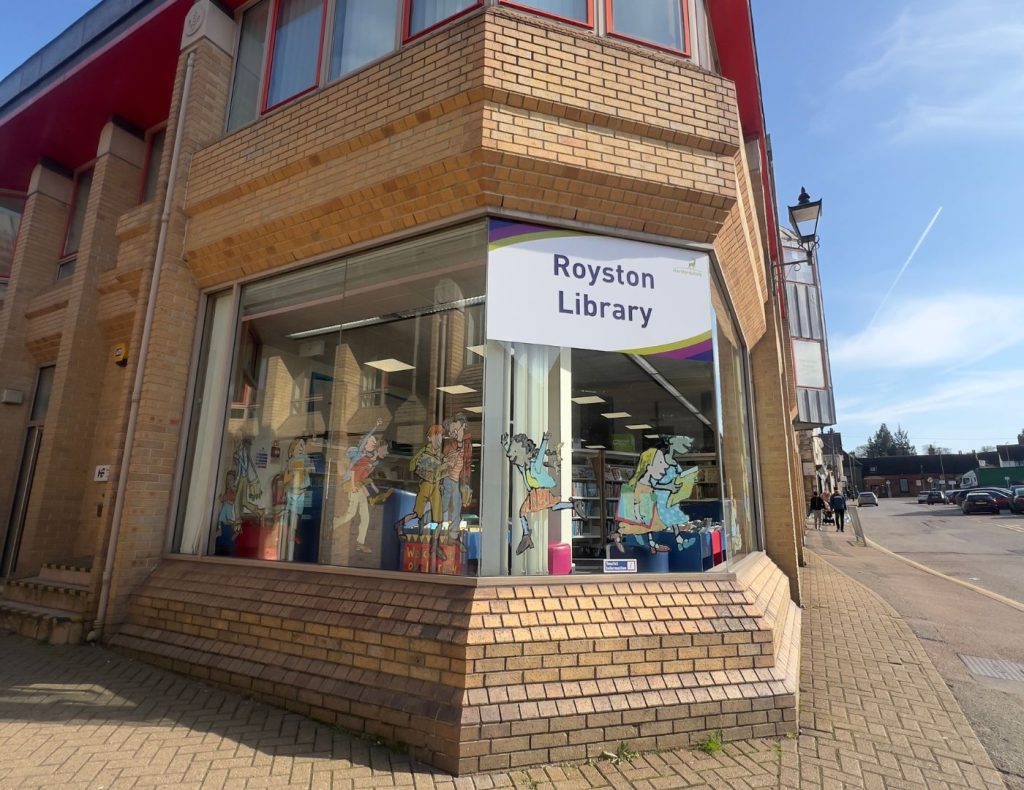
Step inside Royston Library during the week and you’ll still see school groups gathered on bright rugs, listening wide-eyed as a story unfolds. You’ll see children clutching freshly borrowed books like treasures. You’ll see the quiet pride of choosing something for themselves, no algorithm, no suggested feed, just instinct and curiosity. For many schools, library visits remain a small but significant ritual. A day trip that feels different from the classroom. A space where reading isn’t homework, it’s exploration. Where book clubs gather after school and stories are discussed not because they’re on a syllabus, but because they sparked something. That magic, the one so many remember, hasn’t disappeared. It’s just shifted generations.
For children, the library can still feel like stepping into another world. The shelves are still tall. The stories are still endless. The sense of possibility is still there, waiting. And perhaps that’s the real point.
World Book Day is a celebration of books, but it’s also a reminder that the spaces nurturing young readers are still quietly doing their work.
Encouraging curiosity. Creating imagination. Offering access.
The magic was never really about the format.
It was about the invitation.
And for the next generation stepping through those doors, that invitation is still wide open.